
Pt. Ram Sahai Mishra Ji and the Making of the Banaras Gharana: History, Baaj and Shishya Parampara
A history of Pt. Ram Sahai Mishra Ji, the making of the Banaras baaj, and the shishya parampara that carried it forward.
The documented history of the Banaras gharana begins with Pt. Ram Sahai Mishra Ji (1797–1843). This post follows his talim, his break from the Lucknow baaj, the three bases on which he built his own vadan shaili, and the shishya parampara that carried it forward, with a branch chart for every line.
Most of the history below follows Pt. Vijay Shankar Mishra Ji's Tabla Puran. Where an episode rests on oral tradition, the post says "according to Tabla Puran".
Banaras before Ram Sahai Ji
Banaras has long been a principal centre of sangeet, and every vidha has been nurtured here. Tabla vadan existed in the city well before Ram Sahai Ji, but that parampara received little recognition. The recorded history of Banaras tabla starts with him.
Early talim
Ram Sahai Ji's first talim was under his father, Pt. Prakash Mishra Ji, and his uncle. Even before he became a shagird of Ustad Modu Khan Sahab, he was known for his madhur vadan.
Talim under Ustad Modu Khan Sahab, 1807–1819
- In 1807, at the age of ten, Ram Sahai Ji began his talim under Ustad Modu Khan Sahab of the Lucknow baaj. It continued without a break for twelve years.
- Modu Khan Sahab himself offered to teach him after hearing his vadan. He had lost his young son and had no successor to carry his baaj forward, and his own community mocked him as par kate kabootar, a pigeon with clipped wings. He had vowed never to teach a Muslim shagird, which is why no other name appears among his shagirds.
- According to Tabla Puran, during a six-month absence of Modu Khan Sahab from Lucknow, his wife, who came from the Punjab baaj, taught Ram Sahai Ji 500 Punjabi gats.
Is Banaras only the Lucknow baaj?
Some argue that Banaras is not an independent gharana, since its founder was a shagird of Modu Khan Sahab and the tabla played here is therefore Lucknow baaj. The record does not support this view. Ram Sahai Ji already had talim before Lucknow, he held rare bandishes from other gharanas, and he had a creative ability (srijan) of his own.
The Lucknow sammelan of 1819
Nawab Saadat Ali Khan Sahab died in 1814 and Ghazi-ud-din Haider Ji took the gaddi of Awadh. In 1819 a seven-day sammelan was held to mark his coronation. At Modu Khan Sahab's request, the opening vadan went to Ram Sahai Ji.
According to Tabla Puran, his vadan was so effective that he remained the only tabla artist for all seven days. Artists of every gharana acknowledged him as the finest and most unmatched tablist they had heard. They performed bhuja-pujan, a ceremonial honouring of his arms, and presented him with rare bandishes of their own gharanas.
Guru-dakshina and the break from the Lucknow baaj
Under pressure from his community, Modu Khan Sahab took a vachan from Ram Sahai Ji as guru-dakshina: he would neither play the Lucknow baaj anywhere nor teach it to anyone.
On reaching Banaras, Ram Sahai Ji kept this vachan. Crowds gathered to hear and learn from him, and he refused every request to perform or teach. When news of the vachan travelled from Lucknow to Banaras, the need for a separate gharana became clear.
The three bases of the Banaras baaj
Further accounts help describe what made this baaj distinctive: they credit Pt. Ram Sahai Ji with changing hand position and finger use to widen the tabla’s tonal range, and with shaping a style for solo performance as well as dhrupad, thumri, tappa, instrumental music and Kathak. A family account by tabla artist Pt. Sharda Sahai Ji also recounts a seven-night solo without repeating a composition; treat that episode as a lineage account, alongside the version in Tabla Puran. Pt. Sharda Sahai Ji’s account. A separate account describes Pt. Ram Sahai Ji’s six-month retreat as a period of developing the Banaras style; it notes a resonant “Na” played with a curved ring finger and forms including uthan, Banarasi theka and fard. It also stresses the style’s range from delicate khyal to forceful dhrupad and Kathak accompaniment. Benares gharana account.
The dates for Pt. Ram Sahai Ji differ across accounts. This article retains the dates (1797–1843) supplied with Tabla Puran; the Government of India’s Banaras tabla profile gives 1780–1826. The discrepancy is unresolved here, so both are shown rather than silently choosing one. Government of India, Banaras Tabla profile.
- Pre-existing talim. He already played tabla before he learned from Modu Khan Sahab.
- Rare bandishes. Ustads of other gharanas had gifted them to him at the 1819 sammelan.
- Srijan. His own creative ability.
On these three bases he built a new vadan shaili, and it became the Banaras gharana.
Shishya parampara: the first generation
Almost the whole city wished to learn from him, but he accepted only five shagirds, known as the Panch Pyare or Panch Pyade:
- Mastram Pt. Ram Sharan Mishra Ji
- Pt. Pratap Maharaj Ji
- Pt. Baiju Ji
- Pt. Bhagat Ji
- Pt. Yadunandan Ji
Beyond these five, two members of his family also carried the baaj. His younger brother Pt. Janki Sahai Ji left nritya and received advanced talim in tabla. Pt. Bhairav Sahai Ji, the son of his brother Pt. Gauri Sahai Ji, was his last shagird, taken in his final days.
Pt. Ram Sahai Ji passed away in 1843, aged 46.
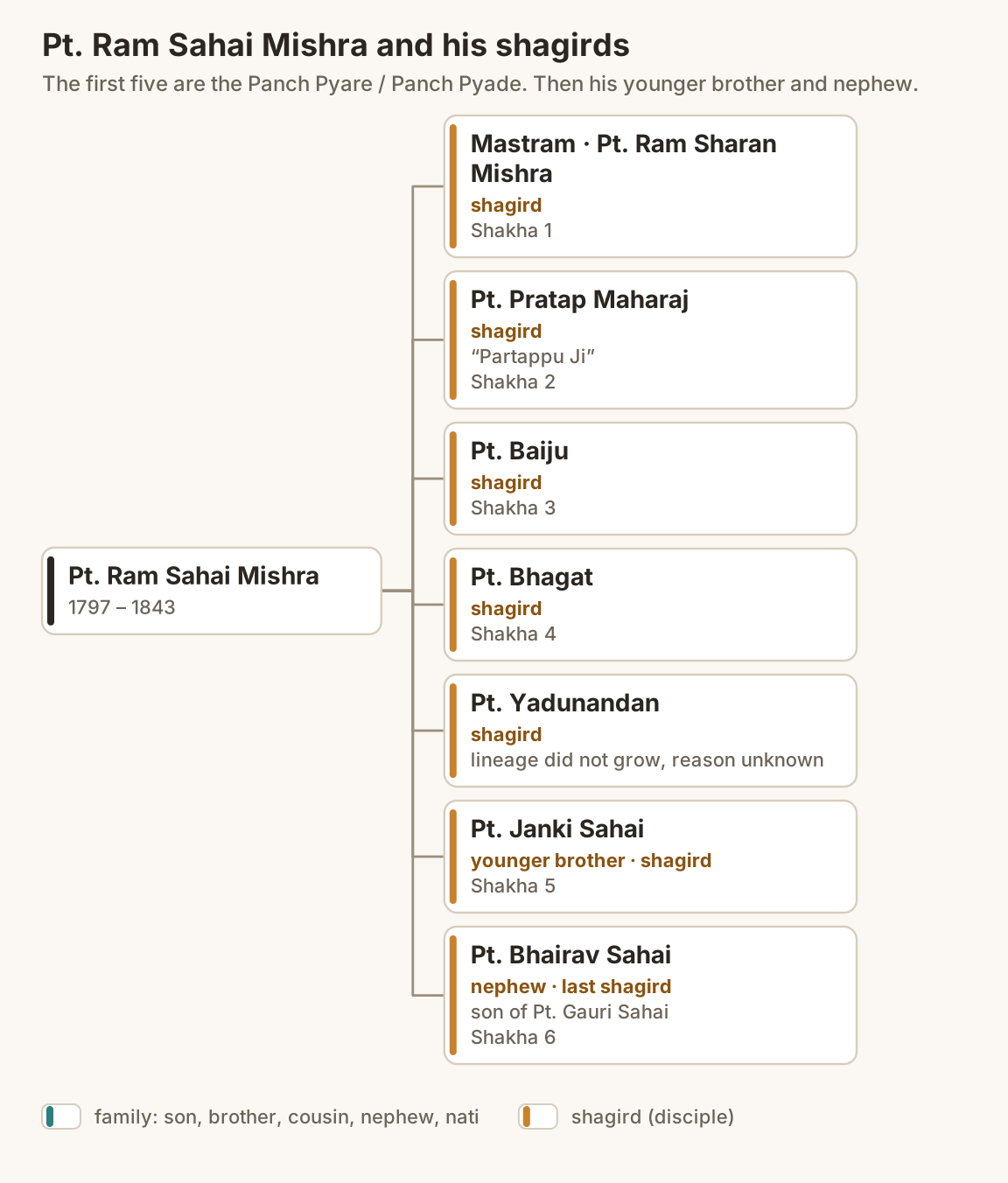
Pt. Yadunandan Ji's lineage did not grow, and the reason is unknown. The other six names grew into the six branches (shakha) below.
The six branches of the Banaras gharana
In the charts, a teal bar marks a family relation (son, brother, cousin, nephew, nati) and an amber bar marks a shagird. A dashed box means the same person appears in another branch too, and a dotted line means "also learned from". Each chart records the main lines handed down. It is not a list of every shagird of every ustad.
Shakha 1: Mastram Pt. Ram Sharan Mishra Ji
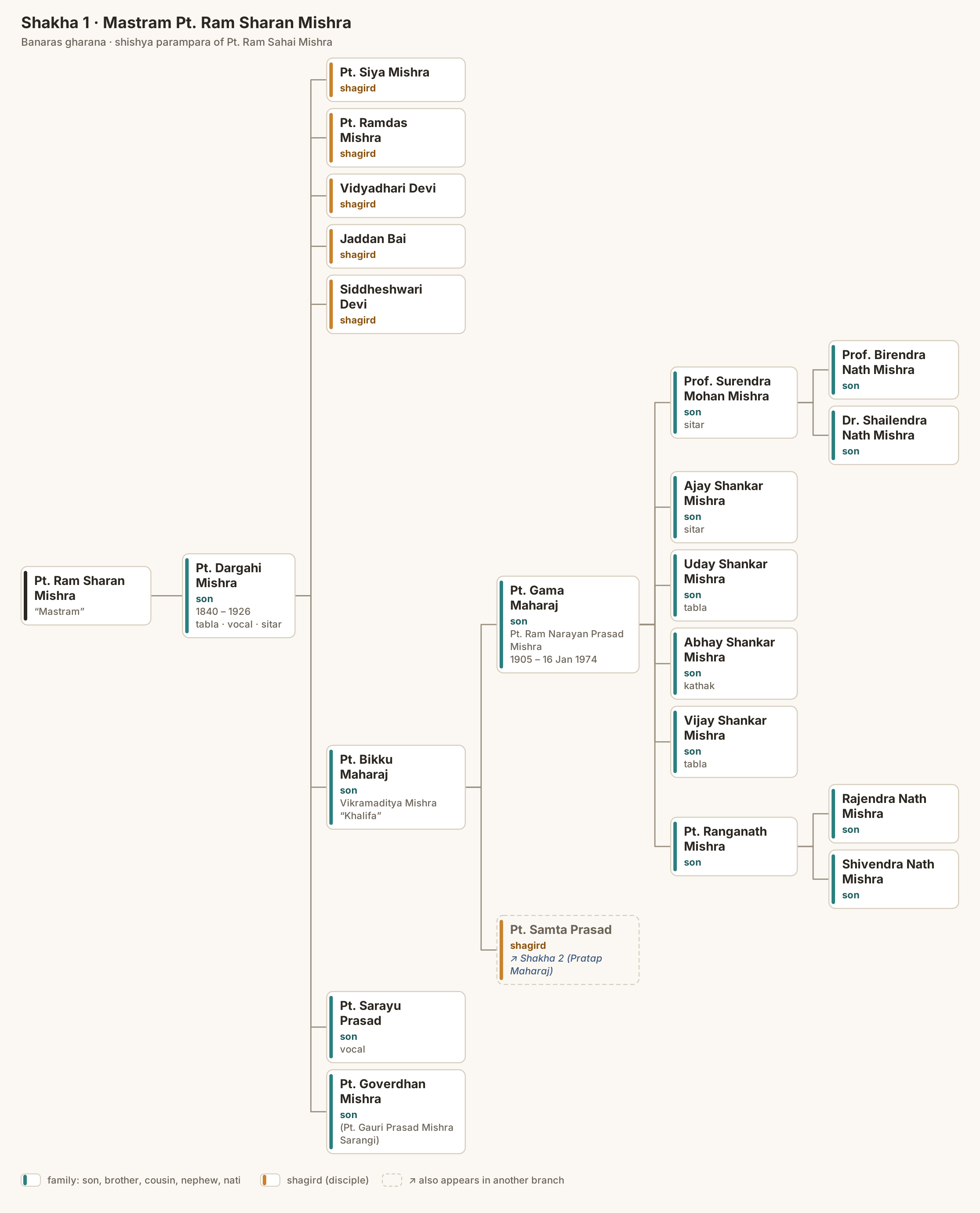
Pt. Ram Sharan Mishra Ji’s son, Pt. Dargahi Mishra Ji (1840–1926), played tabla, vocal and sitar. His shagirds include Pt. Siya Mishra Ji, Pt. Ramdas Mishra Ji, Vidyadhari Devi Ji, Jaddan Bai Ji and Siddheshwari Devi Ji. His sons were Pt. Bikku Maharaj Ji (Vikramaditya Mishra Ji), Pt. Sarayu Prasad Ji (vocal) and Pt. Goverdhan Mishra Ji.
Pt. Bikku Maharaj Ji's son, Pt. Gama Maharaj Ji (Pt. Ram Narayan Prasad Mishra Ji, 1905 – 16 January 1974), had six sons: Prof. Surendra Mohan Mishra Ji (sitar), Ajay Shankar Mishra Ji (sitar), Uday Shankar Mishra Ji (tabla), Abhay Shankar Mishra Ji (kathak), Vijay Shankar Mishra Ji (tabla) and Pt. Ranganath Mishra Ji. Prof. Surendra Mohan Mishra Ji’s sons are Prof. Birendra Nath Mishra Ji and Dr. Shailendra Nath Mishra Ji. Pt. Ranganath Mishra Ji’s sons are Rajendra Nath Mishra Ji and Shivendra Nath Mishra Ji. Pt. Samta Prasad Ji also learned from Bikku Maharaj Ji (see Shakha 2).
One descendant’s professional path is documented by the University of Delhi: tabla artist Pt. Uday Shankar Mishra Ji began training with Pt. Gama Maharaj Ji and has taught since 1983. University of Delhi profile of Pt. Uday Shankar Mishra Ji.
Shakha 2: Pt. Pratap Maharaj Ji
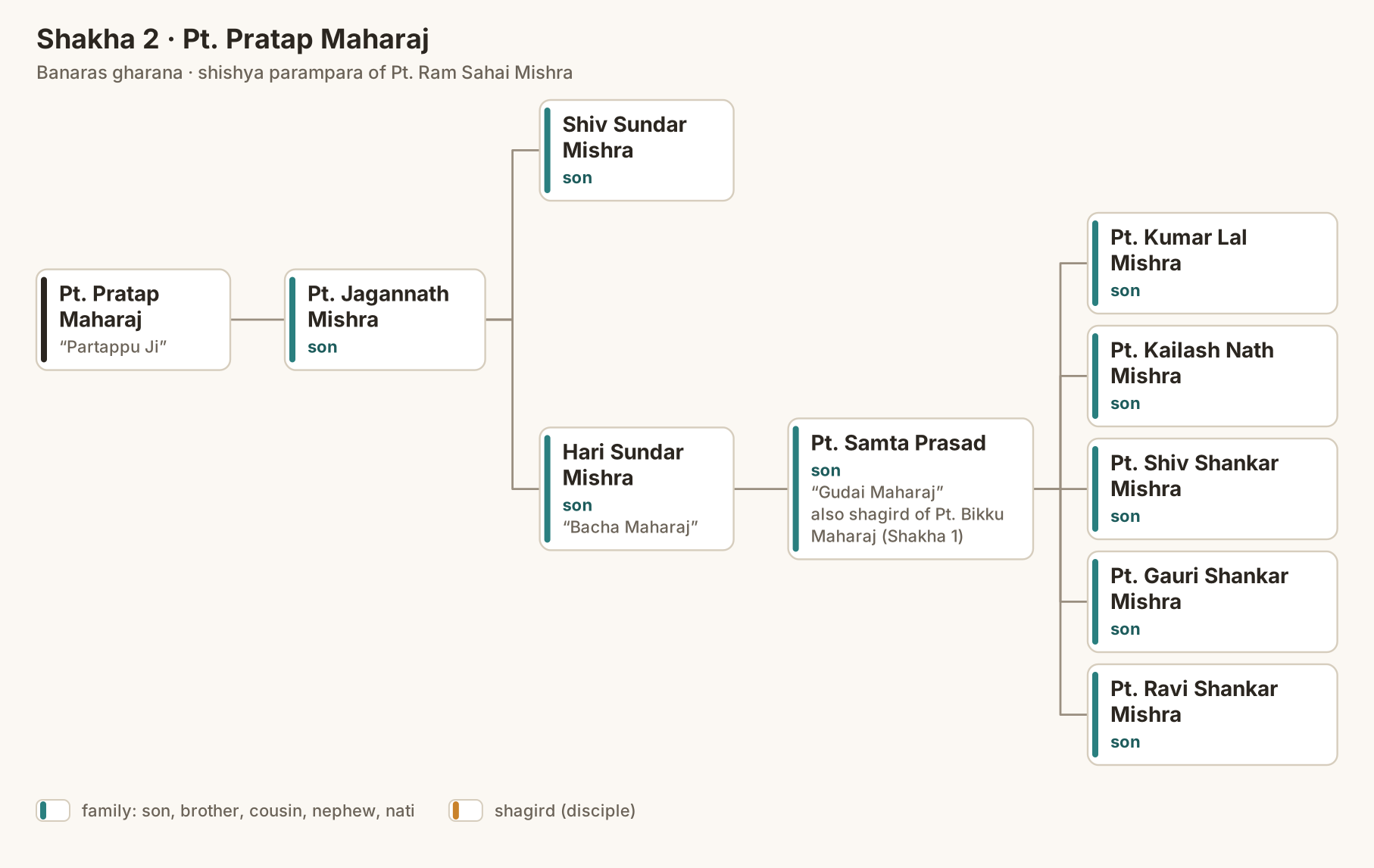
Pt. Pratap Maharaj Ji was known as "Partappu Ji". His son Pt. Jagannath Mishra Ji had two sons, Shiv Sundar Mishra Ji and Hari Sundar Mishra Ji ("Bacha Maharaj Ji"). Hari Sundar Mishra Ji’s son is Pt. Samta Prasad Ji ("Gudai Maharaj Ji"), who also learned from Pt. Bikku Maharaj Ji (Shakha 1). Samta Prasad Ji had five sons: Pt. Kumar Lal Mishra Ji, Pt. Kailash Nath Mishra Ji, Pt. Shiv Shankar Mishra Ji, Pt. Gauri Shankar Mishra Ji and Pt. Ravi Shankar Mishra Ji.
The Sangeet Natak Akademi’s profile of Pt. Samta Prasad Ji identifies him as Gudai Maharaj Ji, records that he first trained with his father through age nine and later studied with Pt. Vikku (Bikku) Maharaj Ji, and documents his Sangeet Natak Akademi Award in 1979. It also places him in a multi-generational tabla family through Pt. Pratap Maharaj Ji, Pt. Jagannath Maharaj Ji and Pt. Baccha Maharaj Ji. Sangeet Natak Akademi profile of Pt. Samta Prasad Ji.
Shakha 3: Pt. Baiju Ji
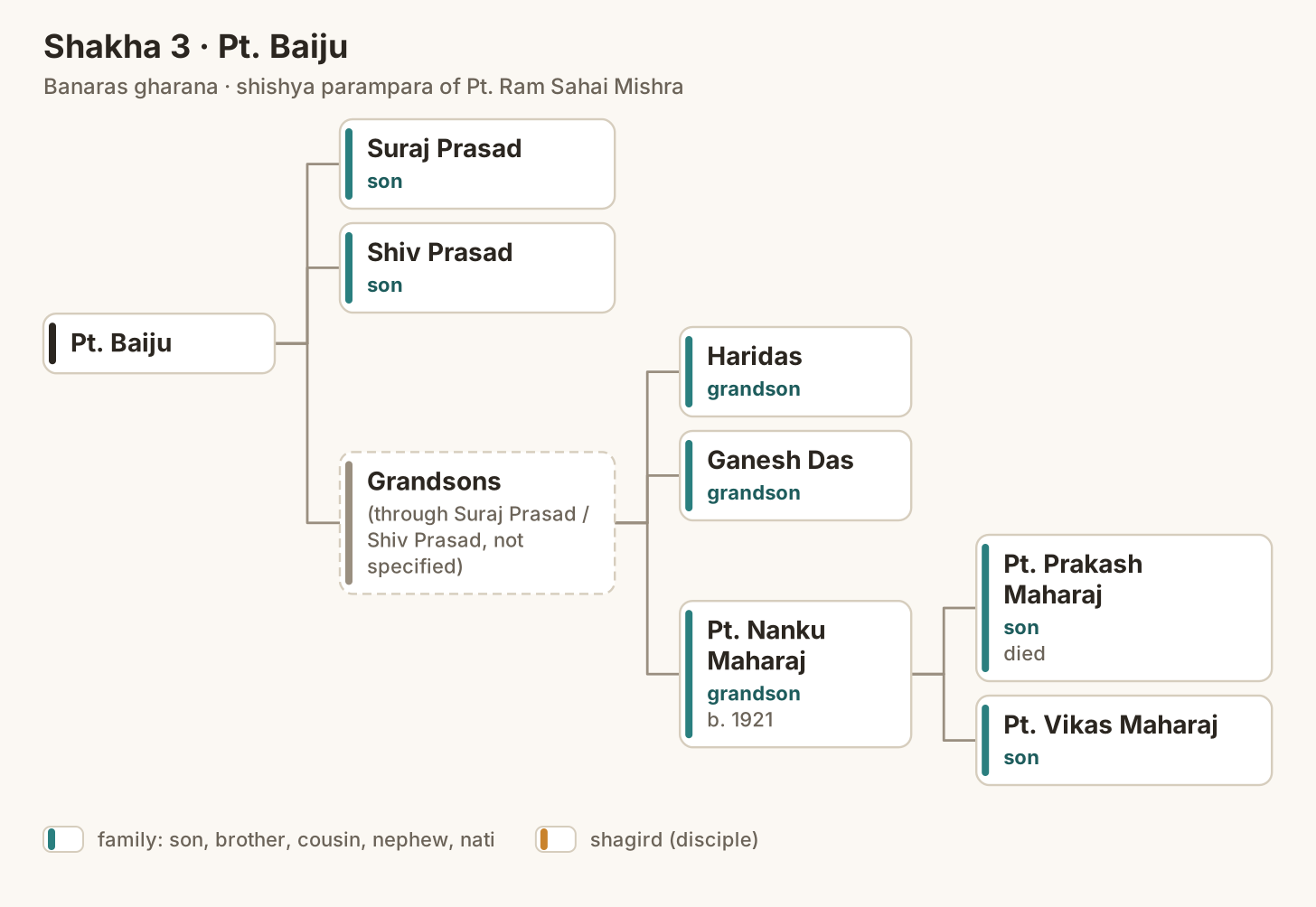
Pt. Baiju Ji's sons were Suraj Prasad Ji and Shiv Prasad Ji. His grandsons are Haridas Ji, Ganesh Das Ji and Pt. Nanku Maharaj Ji (b. 1921), whose sons are Pt. Prakash Maharaj Ji (died) and Pt. Vikas Maharaj Ji. The record does not say which of the two sons each grandson descends from, so the chart shows the grandsons as one group.
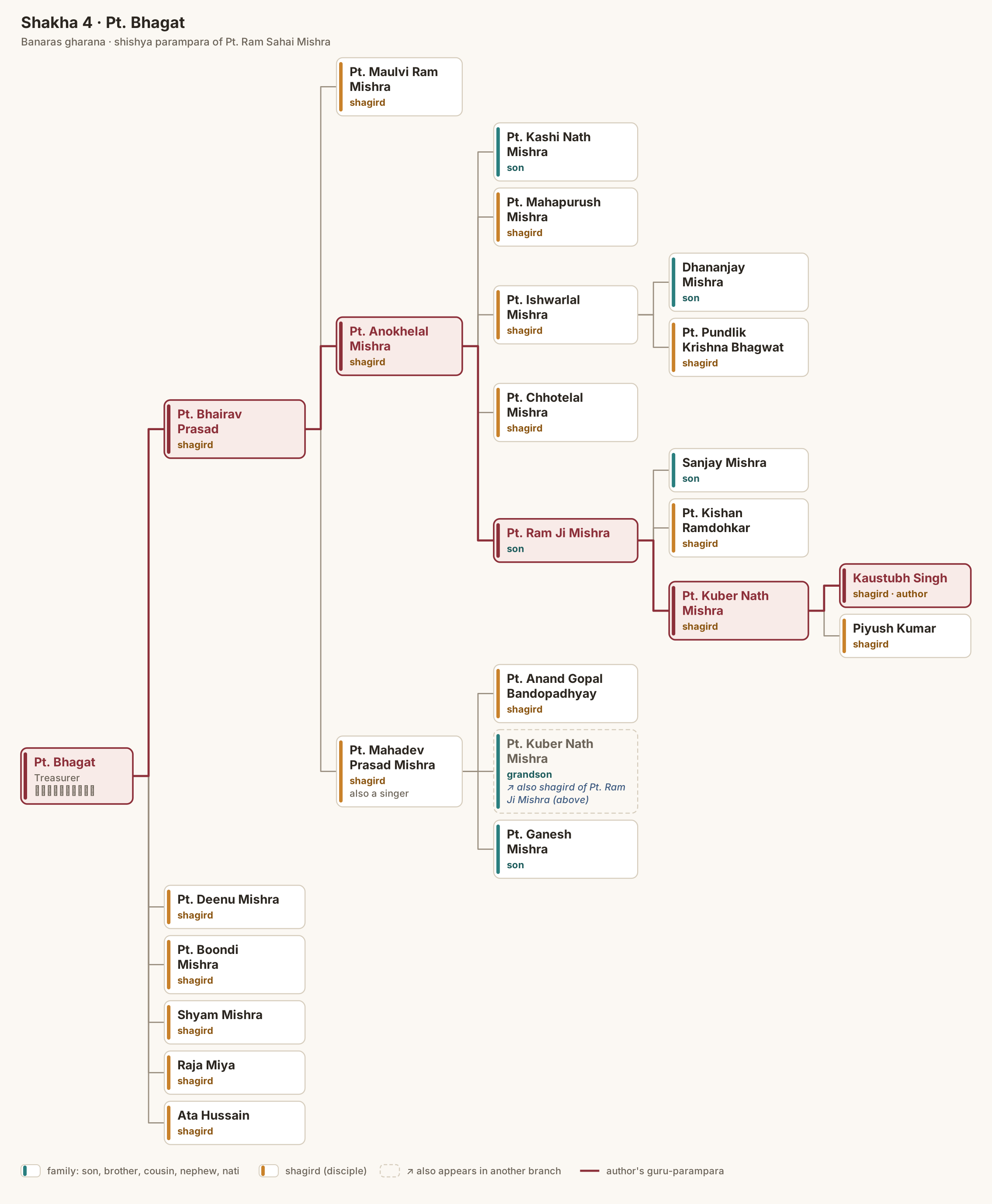
Shakha 4: Pt. Bhagat Ji
Pt. Bhagat Ji served as treasurer (कोषाध्यक्ष). His shagirds were Pt. Bhairav Prasad Ji, Pt. Deenu Mishra Ji, Pt. Boondi Mishra Ji, Shyam Mishra Ji, Raja Miya Ji and Ata Hussain Ji.
Pt. Bhairav Prasad Ji taught Pt. Maulvi Ram Mishra Ji, Pt. Anokhelal Mishra Ji and Pt. Mahadev Prasad Mishra Ji, who was also a singer.
Pt. Anokhelal Mishra Ji had two sons, Pt. Ram Ji Mishra Ji and Pt. Kashi Nath Mishra Ji, and three shagirds: Pt. Mahapurush Mishra Ji, Pt. Ishwarlal Mishra Ji and Pt. Chhotelal Mishra Ji. Pt. Ishwarlal Mishra Ji’s son is Dhananjay Mishra Ji and his shagird is Pt. Pundlik Krishna Bhagwat Ji.
Pt. Ram Ji Mishra Ji has a son, Sanjay Mishra Ji, and two shagirds: Pt. Kishan Ramdohkar Ji and Pt. Kuber Nath Mishra Ji. Pt. Kuber Nath Mishra Ji is also the grandson of Pt. Mahadev Prasad Mishra Ji. Pt. Mahadev Prasad Mishra Ji’s shagird is Pt. Anand Gopal Bandopadhyay Ji and his son is Pt. Ganesh Mishra Ji.
Pt. Kuber Nath Mishra Ji's shagirds on this chart are Kaustubh Singh, the author of this blog, and Piyush Kumar Ji. The highlighted line is the author's own guru-parampara: Pt. Bhagat Ji, Pt. Bhairav Prasad Ji, Pt. Anokhelal Mishra Ji, Pt. Ram Ji Mishra Ji, Pt. Kuber Nath Mishra Ji.
A University of Delhi report on the Banaras gharana describes Pt. Anokhelal Mishra Ji as born in 1914 in Tajpur and trained by Pt. Bhairav Prasad Ji. It particularly praises his command of bol production and fast tempi. Those details add context to the chart’s Bhagat Ji–Bhairav Prasad Ji–Anokhelal line. Dr. Ajay Kumar, University of Delhi, Banaras gharana report (2015).
Shakha 5: Pt. Janki Sahai Ji
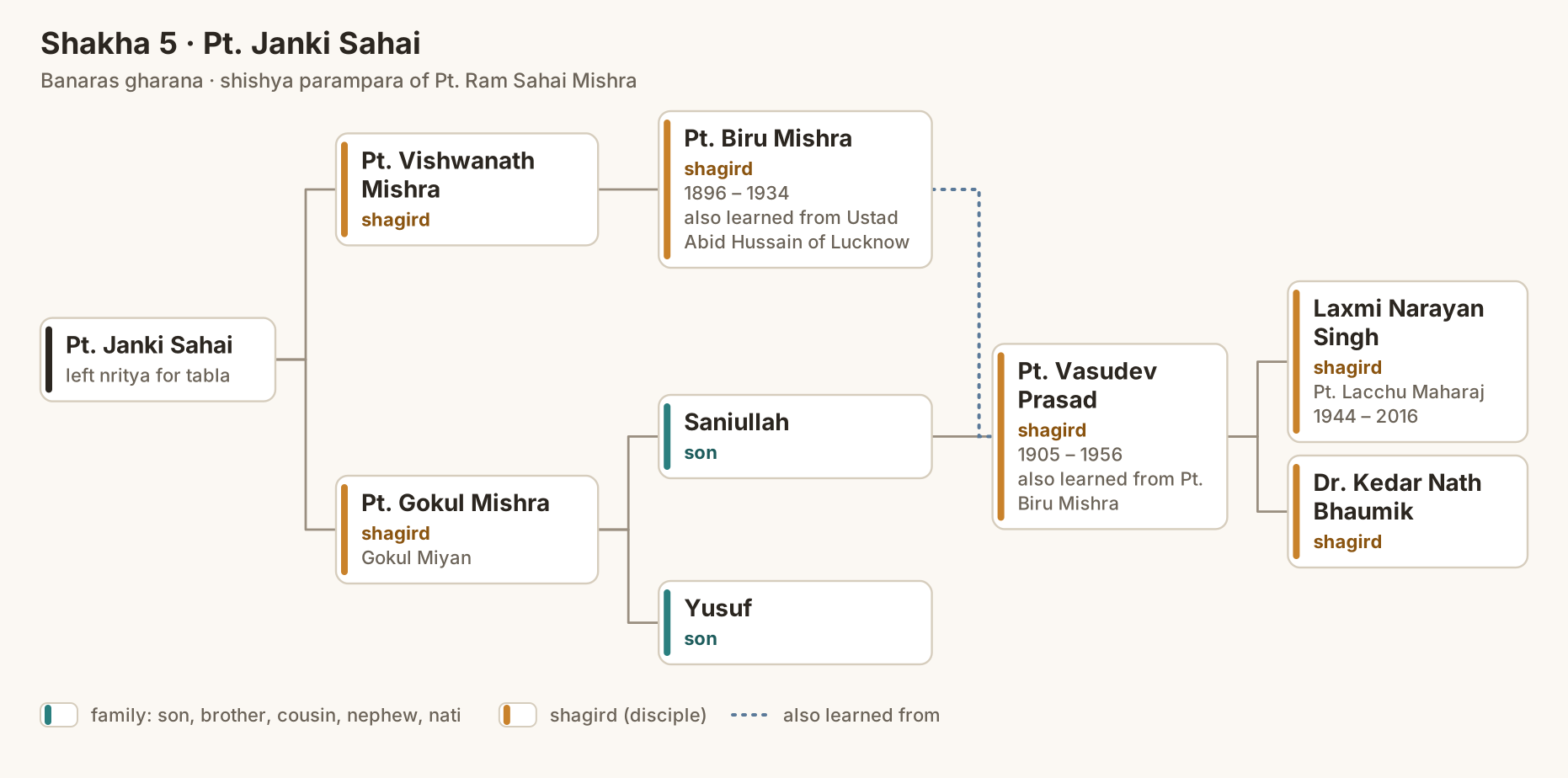
Pt. Janki Sahai Ji had two shagirds, Pt. Vishwanath Mishra Ji and Pt. Gokul Mishra Ji (Gokul Miyan Ji).
Vishwanath Mishra Ji's shagird is Pt. Biru Mishra Ji (1896–1934), who also learned from Ustad Abid Hussain Sahab of Lucknow. Gokul Miyan Ji's sons are Yusuf Ji and Saniullah Ji. Saniullah Ji's shagird is Pt. Vasudev Prasad Ji (1905–1956), who also learned from Biru Mishra Ji. Vasudev Prasad Ji's shagirds are Laxmi Narayan Singh Ji (Pt. Lacchu Maharaj Ji, 1944–2016) and Dr. Kedar Nath Bhaumik Ji.
Shakha 6: Pt. Bhairav Sahai Ji
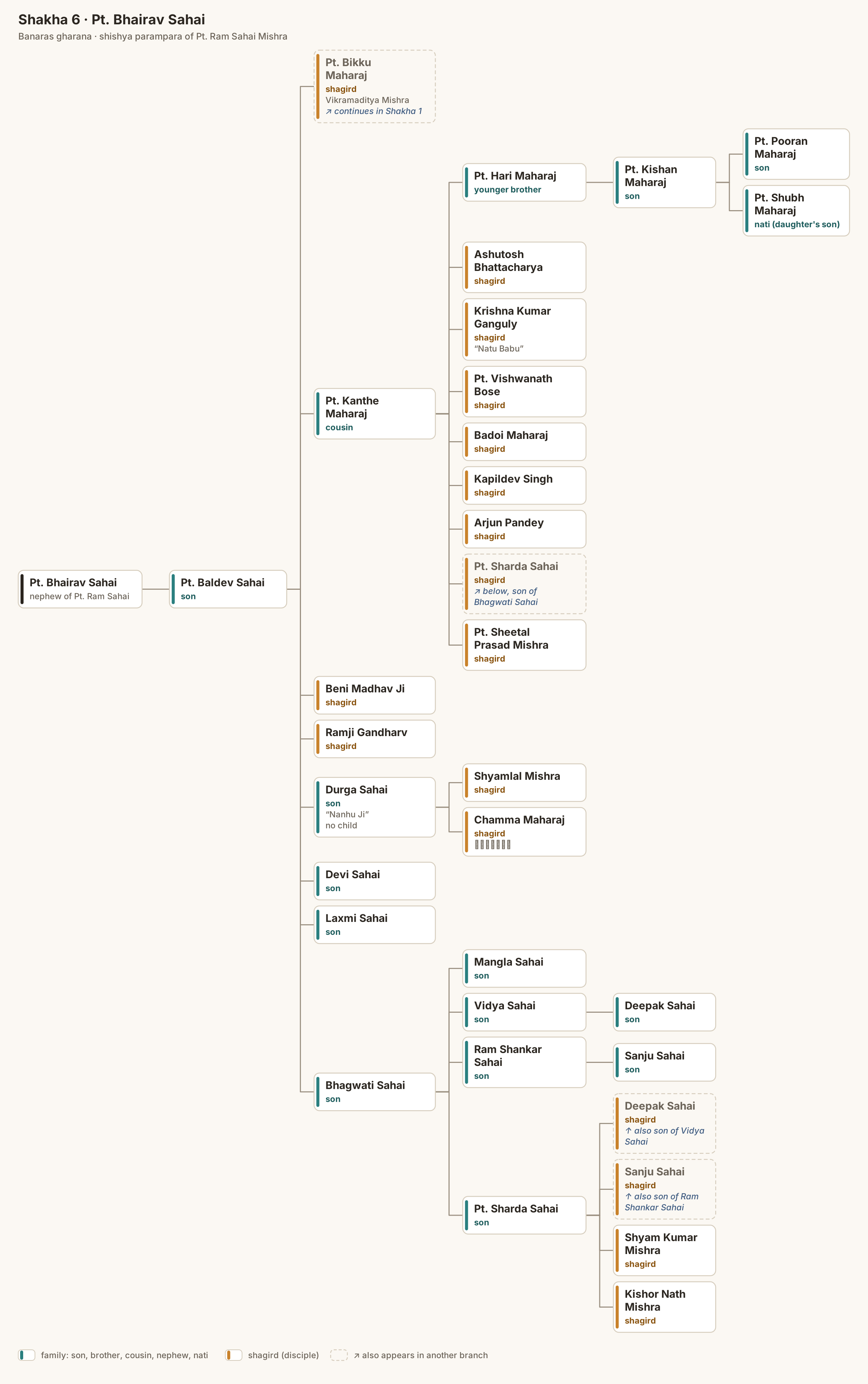
Pt. Bhairav Sahai Ji's son was Pt. Baldev Sahai Ji. His shagirds were Pt. Bikku Maharaj Ji (Vikramaditya Mishra Ji, Shakha 1), Beni Madhav Ji and Ramji Gandharv Ji. His cousin was Pt. Kanthe Maharaj Ji.
Baldev Sahai Ji had four sons:
- Durga Sahai Ji ("Nanhu Ji") had no child. His shagirds are Shyamlal Mishra Ji and Chamma Maharaj Ji.
- Devi Sahai Ji and Laxmi Sahai Ji.
- Bhagwati Sahai Ji, whose sons are Mangla Sahai Ji, Vidya Sahai Ji (son: Deepak Sahai Ji), Ram Shankar Sahai Ji (son: Sanju Sahai Ji) and Pt. Sharda Sahai Ji. Sharda Sahai Ji's shagirds are Deepak Sahai Ji, Sanju Sahai Ji, Shyam Kumar Mishra Ji and Kishor Nath Mishra Ji.
Kanthe Maharaj Ji's younger brother Pt. Hari Maharaj Ji had a son, Pt. Kishan Maharaj Ji, whose son is Pt. Pooran Maharaj Ji and whose nati (daughter's son) is Pt. Shubh Maharaj Ji. Kanthe Maharaj Ji's shagirds include Ashutosh Bhattacharya Ji, Krishna Kumar Ganguly Ji ("Natu Babu Ji"), Pt. Vishwanath Bose Ji, Badoi Maharaj Ji, Kapildev Singh Ji, Arjun Pandey Ji, Pt. Sharda Sahai Ji and Pt. Sheetal Prasad Mishra Ji.
One lineage account says Pt. Bhairav Sahai Ji began learning from Pt. Ram Sahai Ji at age five. When Pt. Ram Sahai Ji became ill, he sent the other students to Pt. Janki Sahai Ji while continuing to teach Bhairav Sahai Ji; after Ram Sahai Ji’s death, Bhairav Sahai Ji also learned from his uncle Pt. Janki Sahai Ji. Benares gharana lineage account.
The Sangeet Natak Akademi records that Pt. Kishan Maharaj Ji was born in Varanasi in 1923 and trained under Pt. Kanthe Maharaj Ji. Its profile notes his work as both soloist and accompanist, including for Kathak, and lists the Padma Shri (1973), Sangeet Natak Akademi Award (1984), Padma Vibhushan (2002) and an honorary D.Litt. (2004). Sangeet Natak Akademi profile of Pt. Kishan Maharaj Ji.
The Sharda Sahai family biography adds that Pt. Sharda Sahai Ji began performing professionally at nine and founded the Pandit Ram Sahai Sangit Vidyalaya in 1965. It describes his work as both soloist and accompanist. Pt. Sharda Sahai family biography.
Research notes and date differences
Gharana histories preserve oral memory as well as documented biography. Where a lineage account and a public institutional biography differ, this article attributes the account and makes the difference visible instead of presenting either version as settled fact.
Terms used in this post
- Talim: training under a guru.
- Baaj: the style of playing of a gharana.
- Bandish: a fixed composition.
- Vadan shaili: style of playing.
- Srijan: creative ability.
- Shagird: disciple.
- Vachan: a solemn promise.
- Guru-dakshina: the offering a shagird gives to the guru.
- Sammelan: a festival of music.
- Nati: a daughter's son.
Source: Mishra, Vijay Shankar. Tabla Puran. The lineage charts follow the same source. The two names under Pt. Kuber Nath Mishra Ji were added by the author.