 Tabla I/O
 — Digital Tabla Notation Website
A descriptive study of the website's purpose, product design, core capabilities, and role in a tabla learning workflow.
Abstract
This paper presents Tabla I/O as a digital workspace designed for writing, organizing, and sharing tabla compositions in Bhatkhande-style notation. It examines the website as a case study through a descriptive review of its public pages, workspace interface, product documentation, and implementation structure. The analysis identifies four connected functions: notation authoring, multilingual presentation, reference and learning resources, and digital storage and distribution. Features include a structured notation grid, quick bol entry, English and Hindi display, composition and taal libraries, PDF export, sharing, cloud synchronization for signed-in accounts, and a Layakari Studio. The case illustrates how a domain-specific website can connect notation work with reference material and publishing workflows. The available evidence documents the product's design and advertised capabilities; it does not establish learning gains, adoption, accuracy across gharanas, or long-term preservation outcomes. The paper therefore describes Tabla I/O's contribution as infrastructure for notation work and identifies user research and independent evaluation as necessary next steps.
Keywords: Tabla I/O, tabla, digital notation, Bhatkhande notation, music software, Hindustani music, web application
1. Introduction
Tabla compositions are taught, remembered, and discussed through sound, spoken bols, rhythmic cycles, demonstration, and notation. Digital tools can bring some of these activities into one workspace, but their value depends on how well the interface reflects the concepts musicians use. Tabla I/O is a website built around this task: its public description presents it as a Bhatkhande notation workspace for students and teachers, with tools for creating compositions and preparing print-ready notation [1].
This paper studies the website itself. It asks: How does Tabla I/O organize the work of creating, learning, managing, and distributing tabla notation, and what can the available evidence tell us about its strengths and limits? The question matters because a specialized application is more than an editor. Its choices about taal, composition types, scripts, libraries, exports, and storage define the pathway users follow from entering a bol to keeping or sharing a composition.
The analysis places the website in a broader context. Scholarship on Hindustani music publishing describes notation and music-learning books as part of changing pedagogical institutions and musical authority [2]. Research on Indic notation rendering documents the technical challenge of encoding musical structures and scripts that do not map neatly onto common Western staff notation software [3]. These sources offer context for assessing Tabla I/O's design, but they are not evaluations of the website.
2. Method and evidence
This is a descriptive, single-site case study based on documentary and interface analysis. The materials reviewed were Tabla I/O's public landing page, the publicly accessible workspace interface, the Layakari Studio page, the project's README and source structure, and relevant product descriptions visible on the site [1, 4, 7]. The review records stated functions and interface elements, then groups them by user task: composing, consulting references, preparing outputs, and managing work.
The evidence has clear limits. This review did not involve interviews, classroom observation, usability testing, analytics, or a benchmark against other notation applications. Feature descriptions establish what the site presents as available; they do not show how often or successfully people use each feature. The paper makes no causal claims about learning outcomes, and it does not claim that the software captures every performance convention used across tabla gharanas.
Author positionality: The author is the creator of Tabla I/O. This insider perspective supports a detailed account of the design, but it also creates a potential conflict of interest. The analysis is therefore descriptive, states its limits, and identifies independent user evaluation as necessary follow-up work.
3. The website as a connected workspace
Tabla I/O's user journey begins by asking the musician to choose a taal and composition type, then moves into a notation editor. The public workspace exposes a grid-based notation area, a quick-entry field for bols, composition details, and controls for saving, exporting, and sharing [4]. This places the composition itself at the center of the interface, rather than treating it as a generic text document.
The site's public descriptions also connect the editor to adjacent resources: a taal reference, a composition library, a theory library, and a Layakari Studio [1, 4]. In practical terms, these modules form a workflow in which a user can look up a rhythmic framework, create or study a composition, and produce an artifact for practice or teaching. The architecture of the product is therefore both editorial and navigational: it connects making a score with finding and organizing related knowledge.
4. Core capabilities
| Website component | Documented function | Role in the workflow | Visual evidence |
|---|---|---|---|
| Notation editor | Grid-based composition editing with quick bol entry | Creates and revises a structured composition | Figures 2, 8 |
| Multiscript display | English and Hindi presentation of notation | Supports reading preferences without separate composition copies | Figure 2 |
| Taal and composition libraries | Reference thekas, rhythmic structures, and a curated composition collection | Connects notation work to reference and repertoire browsing | Figures 3–5 |
| Export and sharing | PDF output, composition links, and library submission options in the workspace | Moves a composition from private editing to print or distribution | Figures 2, 7 |
| Layakari Studio | Generates and explains rhythmic transformations from a source composition; supports PDF and JSON export | Explores rhythmic variation as a separate but connected task | Figures 2, 6, 8 |
| Account storage | Local composition handling plus cloud save and synchronization for signed-in users | Supports ongoing access and work across sessions/devices | Figure 8 shows account-aware controls; synchronization behavior is documented in [7] |
Multiscript support is particularly relevant to the site's intended audience: the same composition can be viewed in English or Hindi rather than maintained as two independent records [1, 4]. That design reduces duplicate entry and can make a single score more useful in mixed-script teaching settings. Its practical effectiveness, however, would need to be studied with learners and teachers who use those scripts.
The publishing path also shapes the product. PDF export turns editable notation into a stable handout, while share links and library workflows allow selected compositions to be viewed beyond the editor [4]. Cloud storage is account-based, while the site's interface also distinguishes local work and public library access. These pathways make the site useful for different levels of participation: reading, drafting, maintaining a personal collection, and distributing selected work.
Visual walkthrough of the website
The figures below document the interface states discussed in this paper, from starting a composition to consulting reference material and exporting a score. They are presented as evidence of visible design and controls, not as proof of usability, learning outcomes, or successful back-end operations.
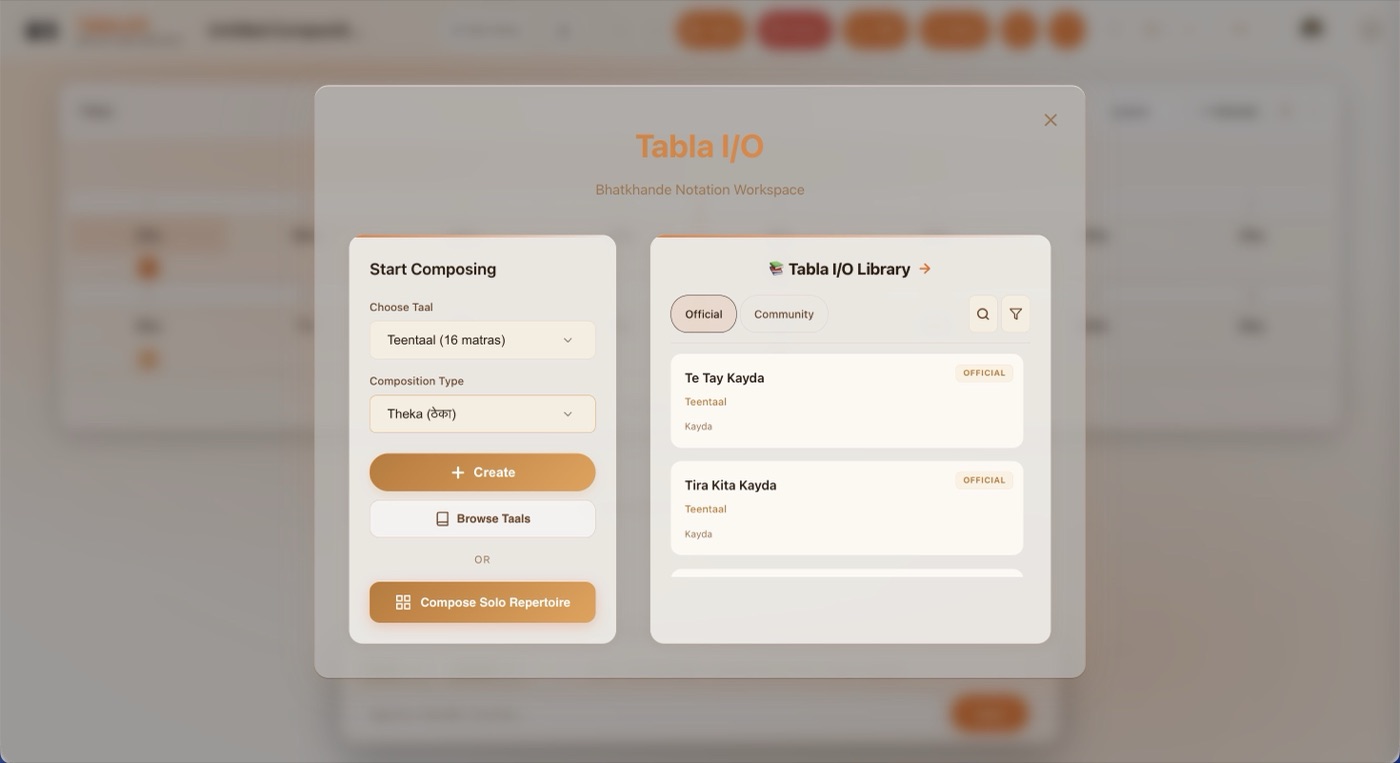
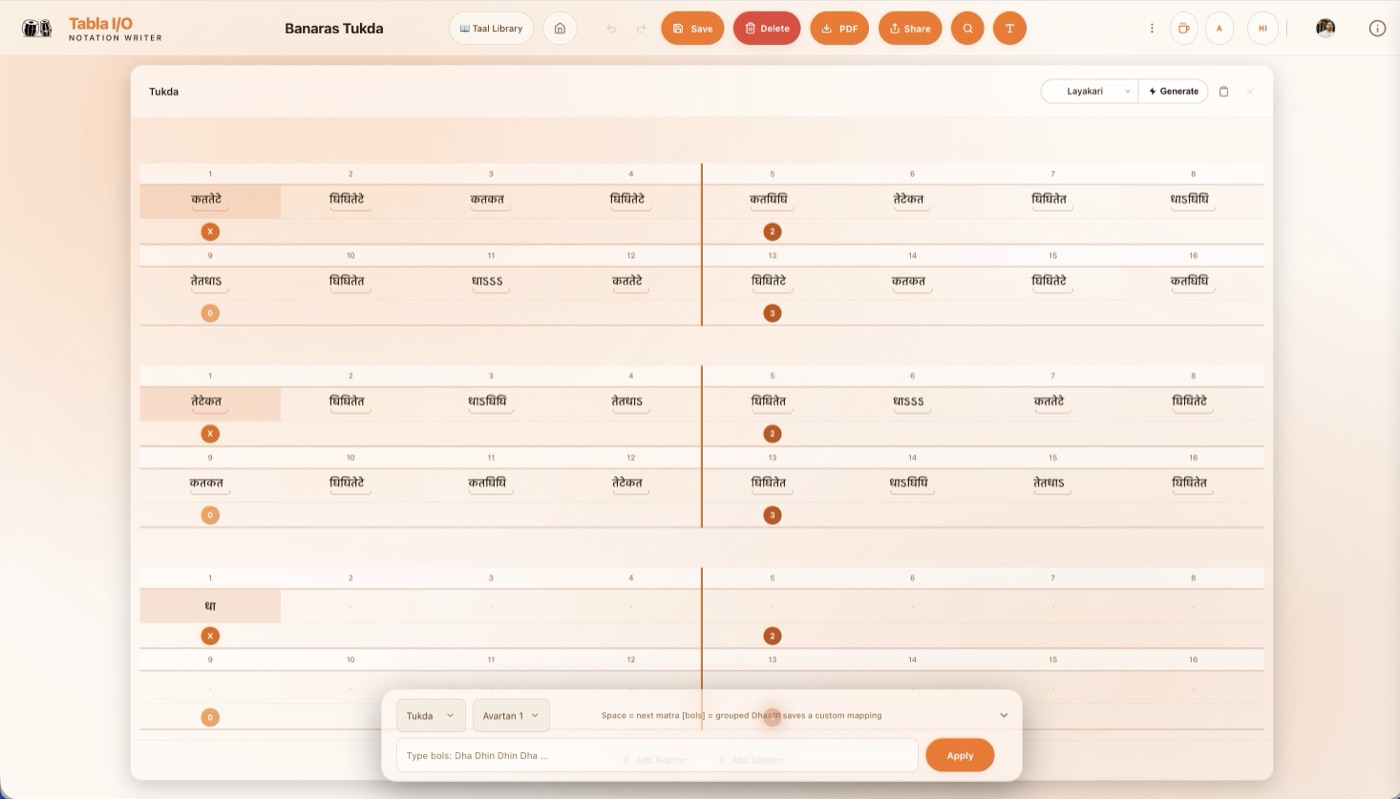
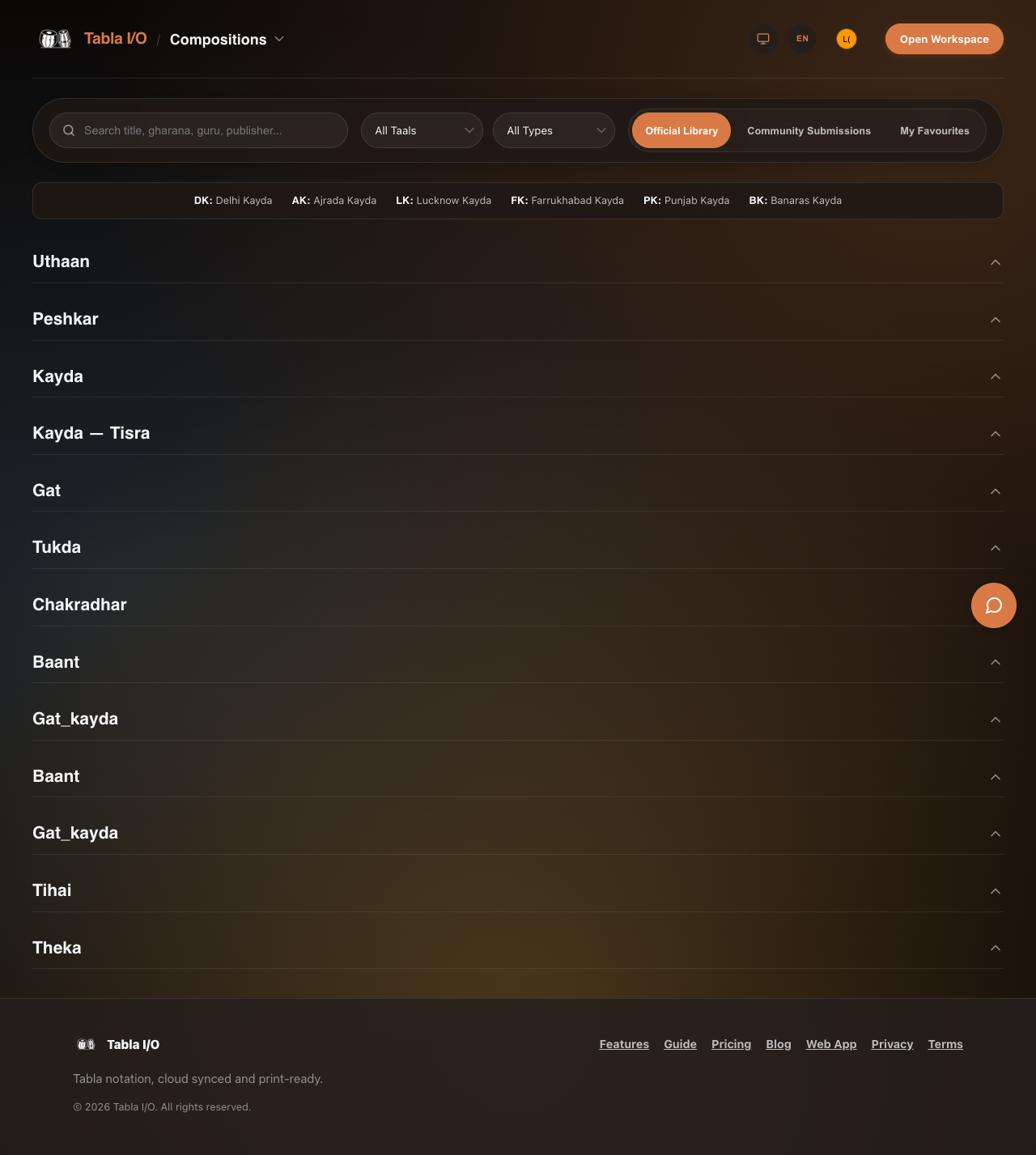
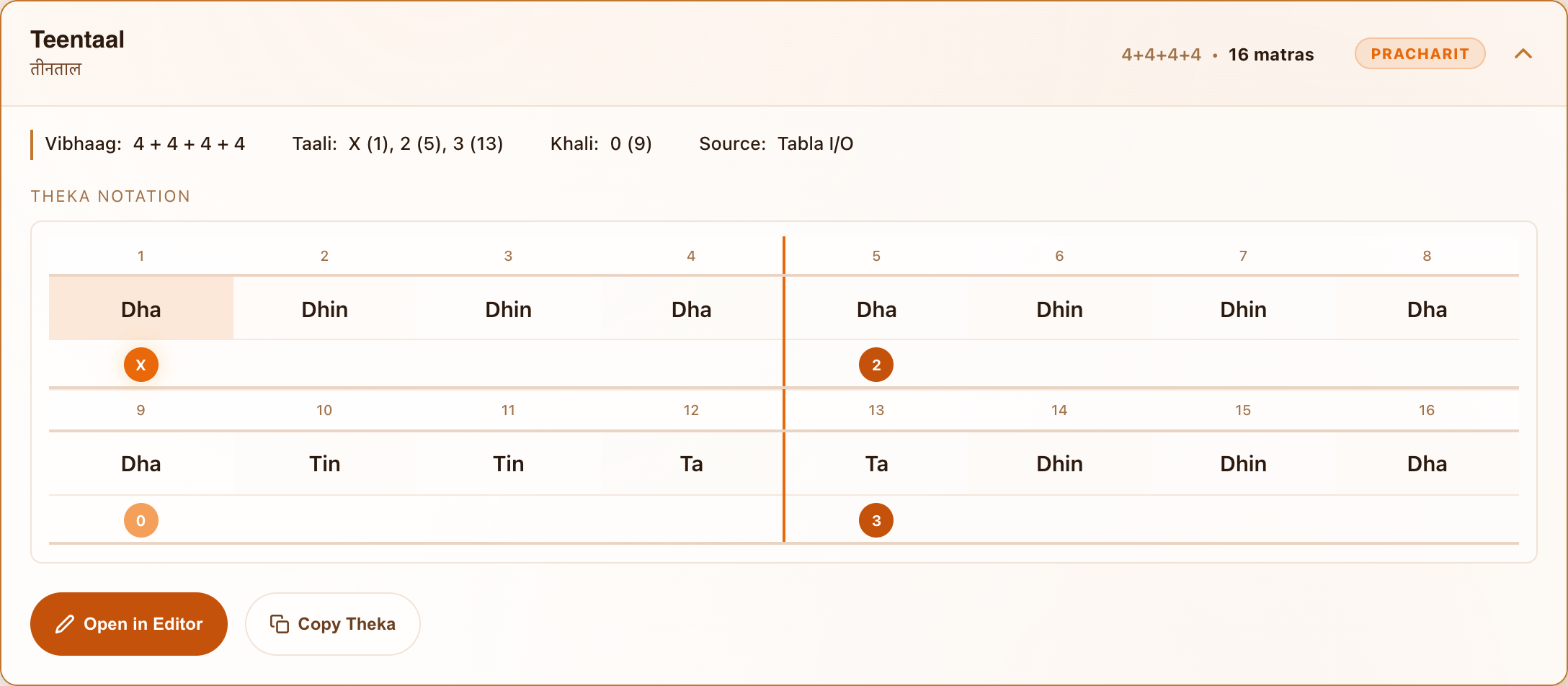
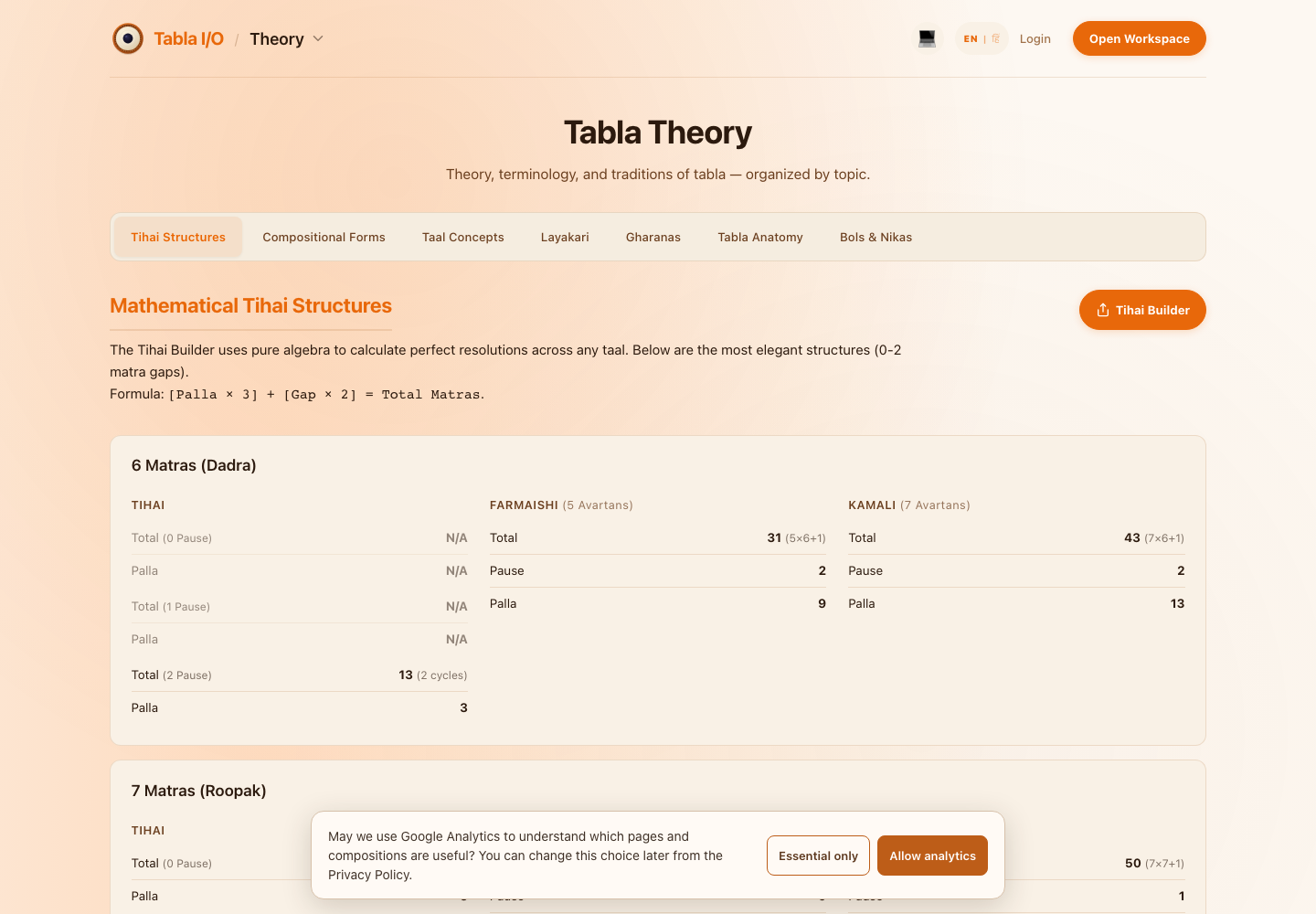
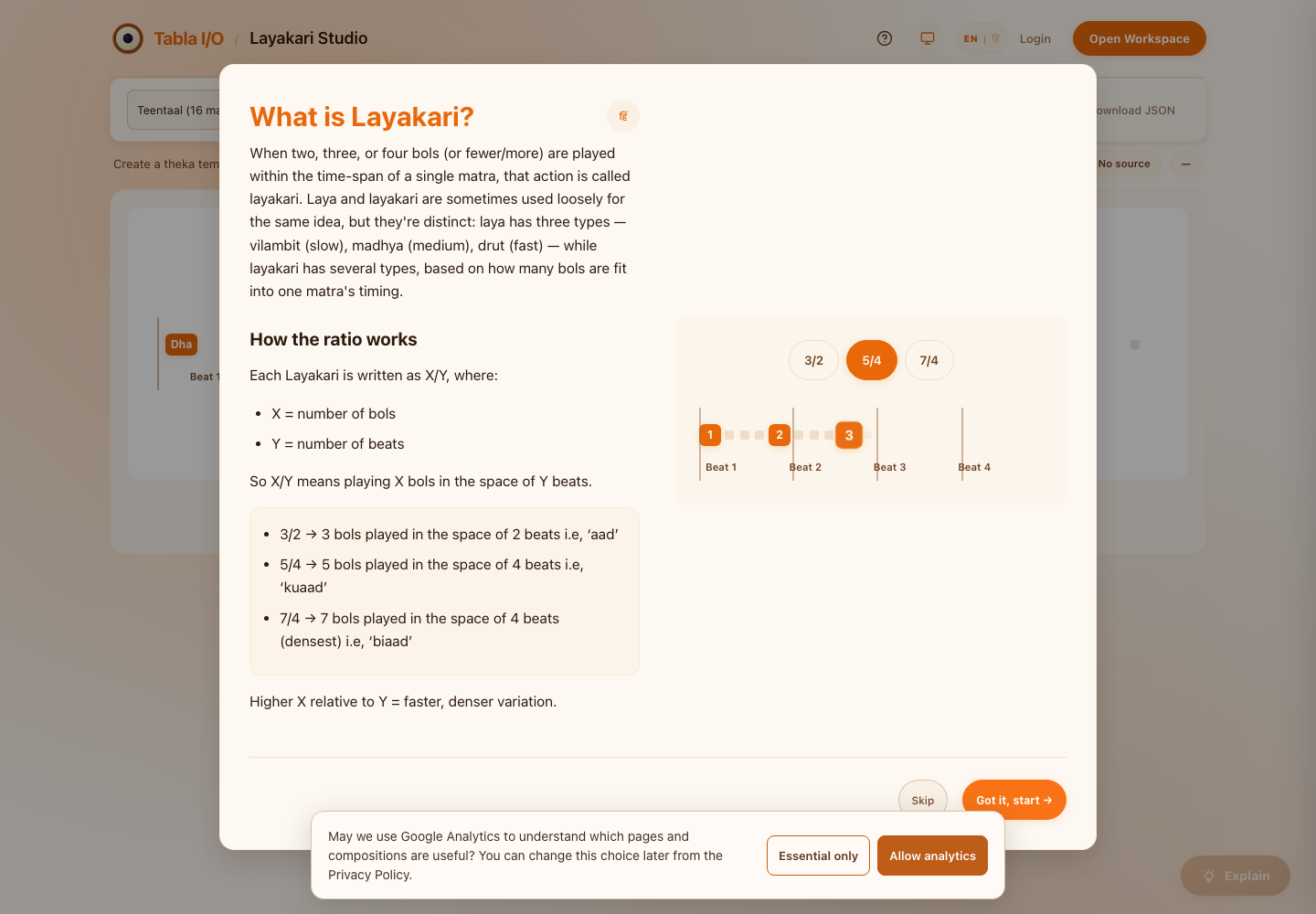
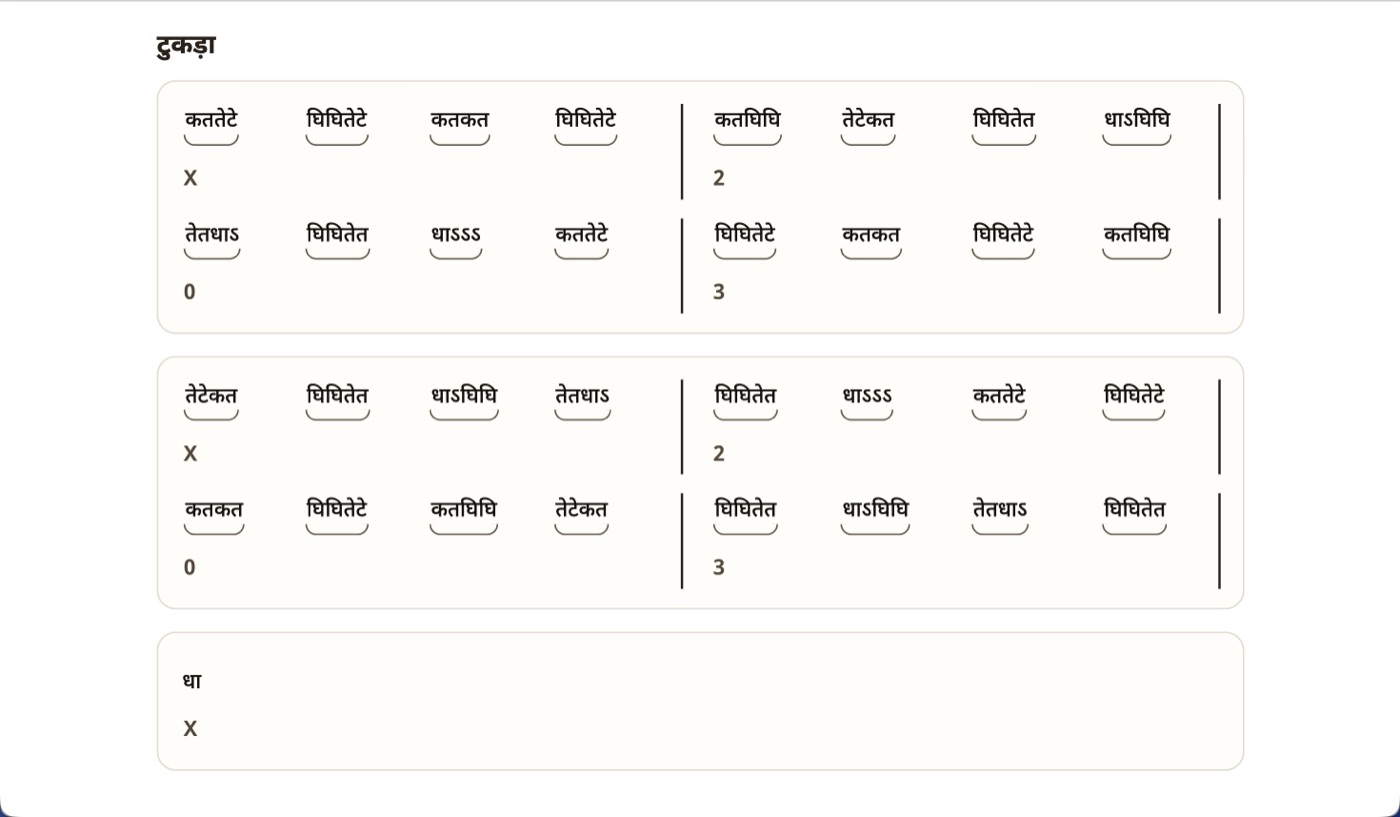
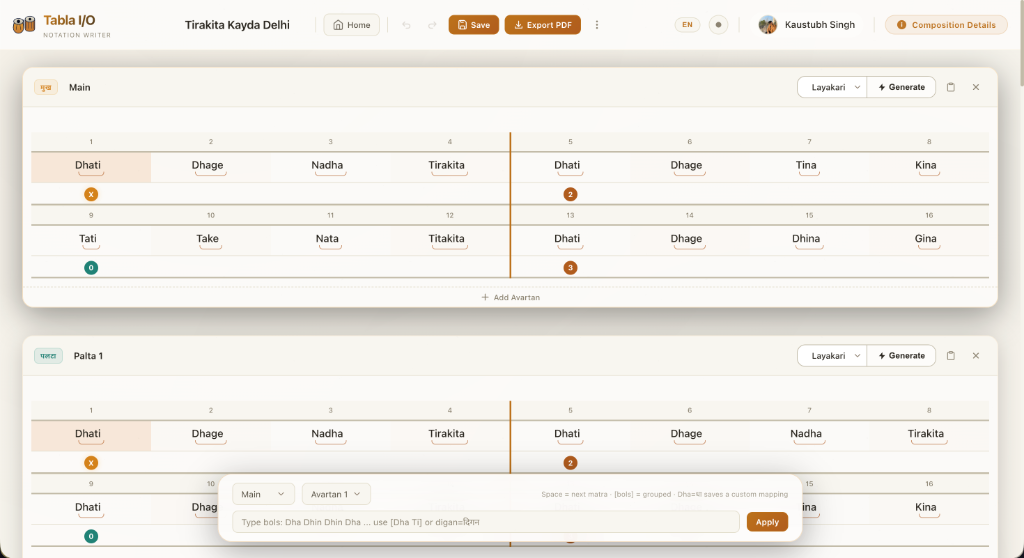
Evidence note: The screenshots support claims about visible screens and controls. Account synchronization, authentication, file handling, and hosting details are based on the product documentation and implementation review [4, 7]; they cannot be established from screenshots alone.
5. Design and technical approach
Tabla I/O uses a domain-specific model of musical work. A composition is associated with a taal and type, and the editor organizes bols in relation to matras and rhythmic sections. This approach is consistent with a broader technical finding in Indic music software research: score layout and data structures need to account for the internal organization of the notation, not merely paint symbols onto a generic staff [3]. The website's grid makes rhythmic placement visible while keeping the input method close to the bol vocabulary musicians already use.
This design choice also reflects a deliberate historical and pedagogical alignment. In North Indian classical music, the two primary 20th-century notation frameworks are the Vishnu Digambar Paluskar system and the Vishnu Narayan Bhatkhande system. While Paluskar's notation utilizes intricate diacritical accents and micro-fractional signs underneath syllables, Bhatkhande's framework models rhythmic cycles as discrete, spatially grouped matra matrices. From a software engineering and user experience perspective, Bhatkhande's matrix architecture translates directly into tabular data structures and responsive DOM layouts, enabling intuitive mobile input and bilingual typography without requiring specialized typographic fonts or cumbersome typesetting machinery.
A related computational problem is the automated generation of non-integer rhythmic variations within the Layakari Studio. Standard tempo multiplication (such as Dugun 2x or Chaugun 4x) doubles or quadruples syllable density per beat. In contrast, complex cross-rhythms such as Aad (3/2 ratio), Kuaad (5/4 ratio), and Biaad (7/4 ratio) require distributing syllables across polyrhythmic intervals that do not align with simple power-of-two beat boundaries. The studio resolves this by computing the lowest common multiple between the source composition's matra subdivision and the target ratio, allocating syllables across discrete integer slots while preserving phrase continuity and resolving mathematically back to the sam.
Project documentation describes a browser-based application with HTML, CSS, and JavaScript front-end modules, Firebase services for sign-in and cloud data, and Firebase Hosting for deployment [7]. The visible workspace includes composition metadata, PDF export, cloud save, sharing, and import/export controls [4]. This architecture provides a practical route to access across devices through a browser. It also makes reliability dependent on browser support, service availability, account configuration, and the ongoing maintenance of both the website and its stored data.
The website's workflow reflects an important distinction between readable notation and complete musical knowledge. A notation system can preserve selected structural relationships, while performance and teaching carry details that may not be fully written down. Studies of Hindustani performance and notation describe printed notation as a reference that performers may elaborate or correct through oral learning [5]. Tabla I/O's value is consequently strongest when framed as a tool for composing, recalling, and sharing notation, not as a substitute for listening, recitation, or instruction.
6. Discussion
Tabla I/O's main contribution is integration. Instead of offering only a notation editor, it places authoring beside taal reference, composition browsing, theory material, export, and rhythmic tools. This can reduce the effort of moving between separate resources during practice preparation. It also creates a coherent digital home for composition work: users can move from selecting a taal to entering bols, refining a score, and generating a printable or shareable output.
The site's specialized interface is also a design commitment. It foregrounds Bhatkhande-style concepts such as taal and matra, and supports English/Hindi display. This specificity can make the product easier to understand for its target users than a general-purpose music editor. At the same time, any notation interface encodes conventions. Teachers may differ in bol spellings, symbols, layout, and performance interpretation. A useful direction for future development and evaluation is to document conventions clearly and study how well the editor accommodates such variation without making one representation appear universal.
Digital recordkeeping raises a further question: what happens to a composition after it is entered? PDF files help users print and read a score, while structured backups and account storage can support continued editing. Long-term preservation additionally depends on durable formats, clear metadata, provenance, and maintenance. UNESCO's digital heritage charter emphasizes active management and continuity across the life of a digital object [6]. The case therefore points to a distinction between making a score available now and ensuring that its content remains understandable and recoverable later.
7. Limitations and future evaluation
This paper evaluates the website through available documentation and interface evidence, not through user outcomes. It cannot establish whether the grid improves notation accuracy, whether quick entry reduces composition time, whether users prefer multiscript display, or whether the library changes learning behavior. Those questions require direct study.
Useful next steps include moderated usability sessions with students and tabla teachers; observation of how a composition moves from lesson to digital score to practice; tests of notation accuracy across varied composition types and conventions; and interviews about export, sharing, and cloud storage needs. Evaluation should include users with different levels of experience and language preference. A separate preservation review could examine backup formats, metadata completeness, version history, and recovery when a user changes devices or a service is unavailable.
8. Conclusion
Tabla I/O is a purpose-built website for creating and managing tabla notation. Its distinguishing product strategy is to join a structured Bhatkhande-style editor with multilingual display, reference libraries, theory material, PDF export, sharing, cloud storage, and a Layakari Studio. This case study documents a coherent workflow for notation work and identifies its promise as practical digital infrastructure for students, teachers, and researchers. Whether that infrastructure improves learning or supports durable cultural preservation remains an open empirical question. The next stage is to evaluate the site with its intended users and to document how its notation, storage, and sharing practices accommodate the diversity of tabla teaching and performance.
References
- Tabla I/O. (2026). Tabla I/O — Digital Tabla Notation. Public website, product description and feature pages. tablaio.com.
- Bhattacharyya, A. (2024). “From Musical Writings to Writing Music: Book-Writing Leading to Music School in Nineteenth-Century Calcutta.” Nineteenth-Century Music Review, 21(3), 492–517. https://doi.org/10.1017/S1479409823000411.
- Misra, C., Chakraborty, T., Basu, A., & Bhattacharya, B. (2016). “Swaralipi: A Framework for Transcribing and Rendering Indic Music Sheet.” Proceedings of the 3rd International Conference on Technologies for Music Notation and Representation (TENOR 2016). Proceedings paper (PDF).
- Tabla I/O. (2026). Workspace and Layakari Studio. Public application interfaces. Workspace; Layakari Studio.
- Clayton, M. (2006). Composition and improvisation in cross-cultural perspective. The Open University, OpenLearn. Section on notation.
- UNESCO. (2003). Charter on the Preservation of Digital Heritage. Adopted 15 October 2003. UNESCO text.
- Tabla I/O. (2026). Tabla I/O — Tabla Notation Workspace. Project README and implementation files. Local project documentation, reviewed 9 October 2026.