
How to Write Bhatkhande Notation: A Beginner's Guide
Every symbol, count, and division explained with bilingual examples—so you can read, transcribe, and compose your first Tabla composition with confidence.
If you've watched a tabla teacher write a composition as a row of syllables, numbers, and marks above particular beats and wondered what they mean, this guide is for you. Bhatkhande notation (भातखंडे स्वरलिपि पद्धति) is the standard notation system for North Indian classical music, formulated by Pandit Vishnu Narayan Bhatkhande. These foundational principles will help you read, transcribe, and write your own compositions with clarity.
1. Start with the Bol
A bol is a spoken syllable associated with a tabla stroke or combination of strokes, such as Dha, Dhin, Ta, Ti, Ge, and Na. Tabla notation writes these bols in playing order and places them within a taal cycle. Unlike melody notation, it does not place drum sounds on a Western pitch staff; Bhatkhande's broader system also includes notation for melody.
2. Matras: Counting the Beats
A matra is one beat. A taal has a set number of matras in each cycle: Teentaal has 16, Jhaptaal has 10, and Rupak has 7. A bol may occupy one matra, or a matra may be divided to fit several bols. For example, dugun (double speed) fits two evenly spaced bols in the time of one matra.
3. Vibhaags: Grouping the Matras
Matras are grouped into vibhaags, or sections, which help performers and listeners follow the cycle. Teentaal's 16 matras are grouped 4+4+4+4. Other taals can have the same total number of matras but different groupings and clap/wave patterns, giving each cycle a different feel.
See Teentaal and other taals in the full Taal Library →
4. Taali and Khali: Clap and Wave Markers
Above certain vibhaags you'll see two kinds of markers:
- Taali (X, 2, 3...) marks a clapped division. The first matra of the cycle, sam, is marked X here; later clapped divisions are commonly numbered with subsequent counts (2, 3, etc.).
- Khali (0) marks a waved division. It is not a silent section: the matras continue and the composition's bols are still played. In Teentaal, the third division begins at matra 9 and is khali.
Crucial distinction: Khali vs. Rest (विश्राम): Beginners frequently mistake Khali for silence. In Hindustani rhythm, Khali simply marks an unaccented, open acoustic division of the cycle (played with open or non-resonant bayan strokes). When a composition requires an actual musical pause or rest during a matra, it is marked by an Avagraha (S / ऽ) or dash (-), not by the vibhaag's Khali marker.
5. Special Symbols and Layakari Subdivisions
How Subdivisions Are Written Under One Matra
In Bhatkhande notation, speed variations (Layakari) are clearly communicated by grouping syllables under a single matra column:
1 syllable per 1 beat. Each bol receives full rhythmic value.
2 syllables evenly packed into 1 beat unit.
4 syllables grouped into 1 beat unit.
6. Putting It Together: Reading a Full Line
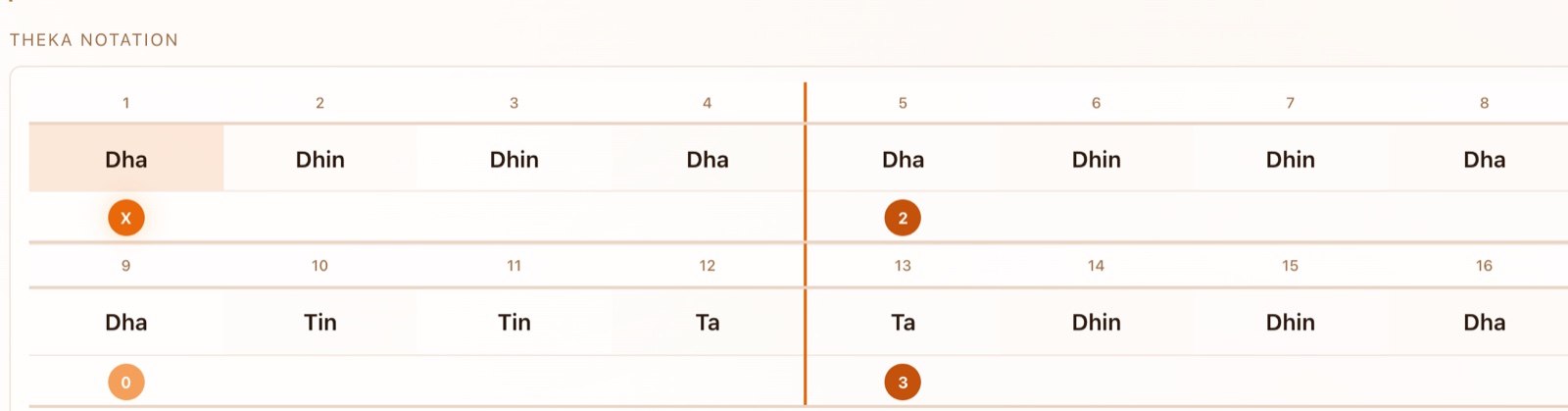
Here is the Teentaal theka as one 16-matra cycle shown in both Roman and Devanagari scripts. The top row marks the vibhaag divisions, the second row numbers the matras, and the bottom rows provide the bols:
| Sam · X | Taali · 2 | Khali · 0 | Taali · 3 | ||||||||||||
| 1 | 2 | 3 | 4 | 5 | 6 | 7 | 8 | 9 | 10 | 11 | 12 | 13 | 14 | 15 | 16 |
| Dha | Dhin | Dhin | Dha | Dha | Dhin | Dhin | Dha | Dha | Tin | Tin | Ta | Ta | Dhin | Dhin | Dha |
| धा | धिं | धिं | धा | धा | धिं | धिं | धा | धा | तिं | तिं | ता | ता | धिं | धिं | धा |
Teentaal theka: 4 + 4 + 4 + 4 matras make one avartan (cycle). Khali marks the open wave on beat 9, but rhythm continues uninterrupted.
To read it aloud, count 1 through 16 without stopping at the khali. The cycle returns to sam at the next beat 1. Gharana nuance: While the theka above illustrates the standard North Indian form starting vibhaag 3 on matra 9 with Dha, some traditions (including Delhi Gharana) recite and write matra 9 as Ta (Ta Tin Tin Ta) to emphasize the open, resonant character of the Khali section.
7. How to Write a Composition Step-by-Step
Whenever you transcribe a composition from your guru or author your own original bandish, follow this reliable five-step sequence:
-
Determine the Taal and Matra Grid: Count the total matras (e.g., 16 for Teentaal, 10 for Jhaptaal, 7 for Rupak) and draw vertical vibhaag barlines (
|) according to the taal's rhythmic structure. - Number the Matras Sequentially: Place matra numbers (1, 2, 3...) above each column. This acts as your rhythmic anchor and prevents accidental beat omission.
- Mark Sam, Claps, and Khali: Mark beat 1 with X for Sam, followed by sequential numbers (2, 3) for subsequent clapped vibhaags, and 0 for Khali divisions.
- Write Bols and Tie Subdivisions: Write one syllable per matra for single speed (Thah). For double speed (Dugun) or quadruple speed (Chaugun), place multiple bols inside the same matra column joined with a tie curve (‿) or hyphen.
-
Account for Pauses and Close the Avartan: Use an Avagraha (S / ऽ) for sustained resonance or rests, and close the cycle with a double barline (
||).
8. Writing It Digitally with Tabla I/O
Handwriting Bhatkhande notation in notebooks works for quick class notes, but it quickly becomes cumbersome when you need neat revisions, student handouts, or bilingual presentation. That is exactly the gap Tabla I/O fills: a structured grid editor that maintains correct matra counts, automates taali-khali placement, supports instant English/Hindi switching, and exports print-ready PDF scores.
Try writing your first composition digitally
Start with the free tier, then save, refine, and export your notation in Tabla I/O.
Open Notation EditorFrequently Asked Questions
What is Bhatkhande notation?
It is a widely used system for writing Hindustani classical music and rhythm using bols, matras, vibhaags, and taali-khali markers instead of Western staff notation.
What's the difference between taali and khali?
Taali is a clap-marked division and khali is a wave-marked division. Khali does not mean that the bols stop; both divisions remain part of the taal cycle.