
 Tabla I/O
Bhatkhande Notation Kaise Likhein: A Beginner's Guide
Every symbol, every count, explained so you can read and write your first Tabla composition with confidence.
If you've ever watched a tabla teacher scribble a composition on paper, a row of syllables, a few numbers, and a couple of marks above certain beats, and wondered what it all means, this guide is for you. Bhatkhande notation is the most widely used system for writing Hindustani classical rhythm, and once you understand five or six core ideas, you can read and write almost any tabla composition in it.
1. Start with the Bol
A bol is a spoken syllable that represents a specific stroke on the tabla, such as Dha, Dhin, Ta, Ti, Ge, and Na. Bhatkhande notation is, at its core, just these bols written out in the order they are played. There is no separate pitch staff like Western notation; the bol itself carries the sound and the technique.
2. Matras: Counting the Beats
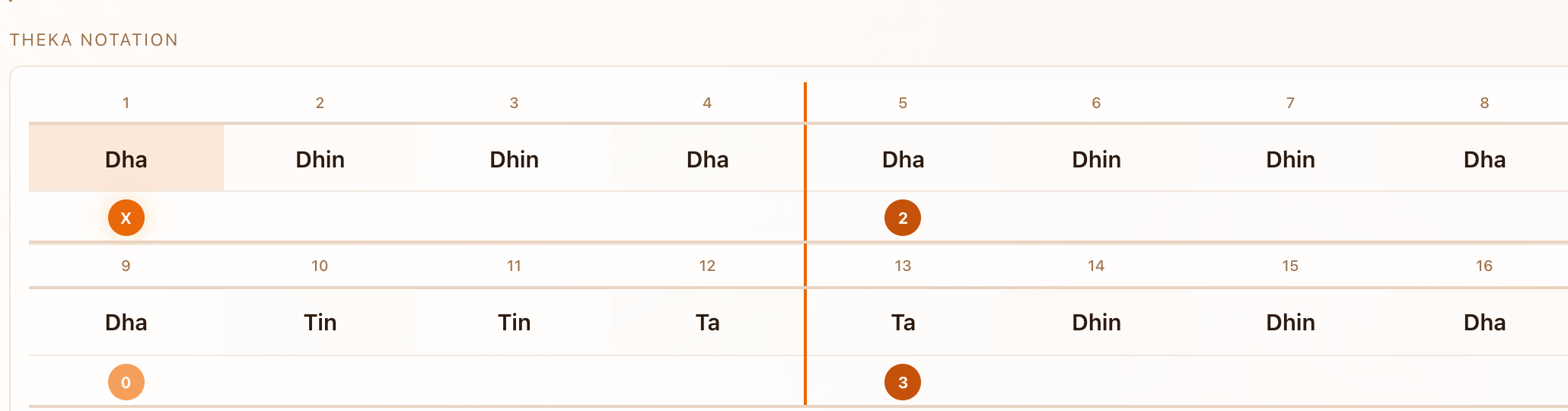
A matra is one beat. Every taal has a fixed number of matras: Teentaal has 16, Jhaptaal has 10, and Rupak has 7. When you write a composition, each bol usually occupies one matra, though faster passages can fit multiple bols inside a single matra when layakari changes the subdivision.
3. Vibhaags: Grouping the Matras
Matras are grouped into vibhaags, or sections. Teentaal's 16 matras are grouped 4+4+4+4. This grouping is what gives a taal its character because two taals can share the same number of matras and still feel very different based on where those divisions fall.
See Teentaal and other taals in the full Taal Library →
4. Taali and Khali: The Accents
Above certain vibhaags you'll see two kinds of markers:
- Taali (X, 2, 3...) marks a clap and signals an accented vibhaag. The first matra of the cycle, the sam, is marked X.
- Khali (0) marks a wave and signals an unaccented or empty vibhaag. In Teentaal, the third vibhaag beginning at matra 9 is khali.
This taali-khali pattern gives a taal its felt shape, even before a listener consciously counts the beats.
5. Special Symbols You'll Run Into
6. Putting It Together: Reading a Full Line
Once you can identify bols, matras, vibhaags, and taali-khali markers, a full line of notation stops looking random and starts reading like a sentence with its own grammar. Most students find that after transcribing a handful of short compositions, the system becomes much more intuitive.
7. Writing It Digitally
Handwriting Bhatkhande notation works, but it gets slow when you need neat revisions, printouts for students, or bilingual notation. That is exactly the gap Tabla I/O was built to fill: a structured grid editor that helps maintain correct matra counts, handles taali-khali placement, and exports print-ready notation.
Try writing your first composition digitally
Free during open beta, with cloud sync and print-ready exports.
Open WorkspaceFrequently Asked Questions
What is Bhatkhande notation?
It is a widely used system for writing Hindustani classical music and rhythm using bols, matras, vibhaags, and taali-khali markers instead of Western staff notation.
What's the difference between taali and khali?
Taali is a clap marking an accented vibhaag, while khali is a wave marking an unaccented one. Together they shape the rhythmic identity of the taal.